Wednesday, April 16, 2025- Punta Marcial, Baja California Sur
After motoring north all night, we woke to find ourselves anchored off the rocky coast of Punta Marcial. We could see the Western Flyer nearby, where her onboard scientists had been up early, taking DNA samples and measurements from the sea.
Western Flyer at Punta Marcial, April, 2025
A few mobula rays poked triangular fins out of the water near the boat, occasionally flinging themselves out of the water like exploding popcorn kernels. Looking out at the Flyer, it was amazing to think that Carol Steinbeck had been in the same vicinity on March 24, 1940, and that the Steinbeck expedition had collected on the same shores we were about to explore. Later that day, I looked back at what the crew had written about the spot 85 years ago.
notes on the Steinbeck expedition in 1940, from my journal of the trip.
Anxious to get in the water, I snorkeled at Punta Marcial, rather than joining the group that went tidepooling that first day. The fish, coral and invertebrates of the underwater landscape were stunning, and afterwards, I shed my wetsuit to explore some of the tidepools before catching a Zodiac back to the big boat.
Punta Marcial tide pools, Baja CaliforniaSunflower Star, Point Marcial, April 2025snails, hermit crabs and chiton, Punta Marcial, April 2025
When we motored back for dinner, the Western Flyer was anchored beside the Safari Voyager. I could hardly wait to visit her in the next day or two.
Western Flyer and Safari Voyager at Punta Marcial
Back on the boat, we each got a sketchbook, watercolor pencils and a brush. For the rest of the trip, I used the art supplies to take notes and make sketches- some “en plein air” and a few from photos I took or objects we found. We were lucky enough to have a professional nature journalist, John Muir Laws, on board to inspire us and give us some workshops. That evening after dinner, one of the wonderful expedition leaders from the Safari Voyager gave a short talk about Baja and the Gulf of California.
Interesting (and sad) fact: The Colorado River once flowed into the norther tip of the Gulf of California, bringing with it red sediments, but dams built by humans over the last hundred years, beginning with the Hoover Dam in 1930, dried up the rich river delta and its ecosystems. Today virtually no fresh water from the river reaches the gulf.
notes from my journalnotes from my journal
And did I mention how beautiful sunsets are on the Gulf?
Over the next week or two, I’ll be posting about a trip I took to the Gulf of California back in April, as I did research for a historical novel about Carol Steinbeck, the first wife of John Steinbeck.
Liz holding a Holothurian (Sea Cucumber) Puerto Agua Verde , April 2025 (photo credit Uncruise Adventures)
Like many travel journals, it is a collection of maps, words, photographs and drawings, but it is also the story of a boat, a famous book, and the fascinating woman who inspired my trip.
The Gulf of California, also known as the Sea of Cortez and the Vermillion Sea, is one of Earth’s most biodiverse ecosystems. Teeming with marine life, it was once nicknamed the “Aquarium of the World” by oceanographer Jacques Cousteau.
The Western Flyer and Safari Voyager anchored in Puerto Agua Verde, Baja California Sur, April, 2025
In April of 2025, I was lucky enough to set sail on the Gulf, taking part in a once-in-a-lifetime trip aboard Uncruise Adventures’ Safari Voyager. For ten days, we traveled alongside the newly restored Western Flyer, following in the footsteps of the famous fishing boat’s 1940 biological collecting voyage.
Map of the Western Flyer voyage in 1940 from The Outer Shores Part 2 by Joel. W. Hedgpeth (out of Print)
(If you compare the maps, you’ll see that while we retraced much of the 1940 route along the Baja peninsula, we didn’t cross over to mainland Mexico.)
Map of the Western Flyer/Safari Voyager route in April 2024
According to Penguin Random House publishers, “The collaboration of two friends—one a novelist, one a marine biologist—produced a volume in which fascinating popular science is woven into a narrative of man’s dreams, his ideals, and his accomplishments through the centuries.”
Biological, philosophical and often funny, the original edition of Sea of Cortez includes a thick phyletic catalogue at the end which details the extensive collection of tidepool animals gathered by Steinbeck’s crew of seven in 1940, as they made a biological exploration of the Gulf’s intertidal species. Here’s a wonderful short film about the voyage, narrated by Nick Offerman and produced by the talented storytellers at Soulcraft Allstars.
In the narrative portion of the book, Steinbeck writes from the perspective of a collective “we,” which clearly includes him and his co-author Ed Ricketts, a marine biologist and early ecologist. He names four other crew members, Tiny, Sparky, Tex and Tony, but neglects to mention that there was also a woman aboard the Western Flyer during their six weeks on the Sea of Cortez.
(photo of Carol Steinbeck from the Martha Heasley Cox Center for Steinbeck Studies- San Jose State University)
The expedition’s seventh crew member was Steinbeck’s first wife Carol, a smart, beautiful woman who swore like a sailor, had a razor-sharp sense of humor, and loved books and red wine. According to Tony Berry, the boat’s captain, she was a helpful crew member, and was always the first person aboard the skiff to go collecting in the tide pools with John and Ed. He also recalled that she was “good” about seventy-five percent of the time. There was trouble brewing on the boat, and Steinbeck would leave Carol for his Hollywood mistress a year after they returned from their famous trip.
(photo of Tex Travis, Carol Steinbeck, Ed Ricketts and John Steinbeck in the Sea of Cortez from the Martha Heasley Cox Center for Steinbeck Studies- San Jose State University)
Carol was John Steinbeck’s primary sounding board and editor during the most critically acclaimed years of his writing career. Not only did she help Steinbeck come up with central themes for his books, but she also came up with the titles for his novels “Of Mice and Men” and “The Grapes of Wrath.” She left no written record of her time aboard the Western Flyer in 1940, but her name is frequently mentioned in the other crew member’s oral and written accounts of the trip.
(Left to right) Sparky Enea, Tex Travis, Rose Berry, Tony Berry, Carol Steinbeck, John Steinbeck, Tiny Colletto (photo from the Martha Heasley Cox Center for Steinbeck Studies- San Jose State University)
I relied on these recollections as I embarked on the adventure of writing a historical fiction novel about the 1940 expedition to the Sea of Cortez, from Carol’s point of view.
My research began in late 2020, when I traveled to the Monterey Peninsula to visit the extensive Steinbeck collections at SJSU and in Salinas and see where Carol lived, worked and played. In 2021, I took trip to the Sea of Cortez. But the last puzzle piece fell into place when I learned that the Western Flyer had been pulled up, rotting and covered in barnacles, from the bottom of a harbor in Anacortes, Washington and was being lovingly restored by Chris Chase and his team of shipwrights as a research and education vessel.
It was amazing to be on the Monterey pier when the Western Flyer returned to the peninsula in 2024. Watching her motor into the harbor, cheered by hundreds, was magical, and I finally got to tour the boat I’d been writing about for four years. I sat on Carol’s bunk, ran my hand across the table in the galley, and walked the decks I’d been writing about. But the top (flying) deck that Steinbeck wrote about so lovingly was roped off, as was the fish hold, which was being transformed into a science lab. I longed to see what it felt like to be aboard the boat when she was out at sea.
And so, when the opportunity arose to join a group of scientists and artists and Steinbeck experts and enthusiasts aboard a boat sailing alongside the Western Flyer upon her return to the Gulf of California, I leapt at the chance to see the boat in action as I immersed myself in nature and Steinbeck lore.
Tuesday,April 14, 2025 (Embarkation at La Paz)
After flying into San Jose del Cabo on Monday, we (my husband Ken and I) took the Uncruise shuttle across the peninsula on Tuesday. The Baja California desert is spectacular, and we spotted several crested caracara falcons sitting atop enormous Cardon cacti as we made our way to La Paz, where our maritime adventure would begin.
La Paz, Baja California Sur, April 2025
Once famous for its beautiful pearls, La Paz is a picturesque seaside town, with whales splashing in the harbor and a palm-lined beach promenade featuring beautiful sculptures. Steinbeck and his crew stopped in La Paz back in 1940, and John’s short novel “The Pearl” was likely inspired by a story he heard there. While anchored in the harbor, Carol reportedly jumped off the boat to swim and ruined an expensive watch John had given her.
Western Flyer and Safari Voyager docked in La Paz, April, 2025
It thrilling to see the Western Flyer and Safari Voyager tied up at La Paz’s city pier as our bus pulled into town. After meeting up with the boats’ crews and our fellow passengers, we set sail under the setting sun, champagne in hand.
La Paz harbor at sunset, April, 2025
Coming up next… Snorkeling and tidepooling at Punta Marcial.
Here’s a fun interview I did with Inside Edition when “Radiant” came out. The video includes lots of great photos and I brought out my own miniscule piece of radium, in an antique spinthariscope, and demonstrated how uranium glass glows under black light! Watch the segment by clicking here.
In April of 1892, Loie Fuller had begun performing her original Serpentine Dance at theaters all over New York City, including Madison Square Theater(New York Hoyt’s company), Palmer’s Theater and Madison Square Garden Concert Hall.
Image from the library of Liz Heinecke. Please request permission before sharing.
By the end of the month, she’d added a flower dance to her repertoire. Unfortunately, her unique dance was so popular that half the other dancers in town tried to copy it.
In February of that year, she had applied for a patent for her Serpentine dance choreography with the U.S. patent office, but it would ultimately be denied. Loie filed an injunction against a competitor named Minnie Renwood, who was imitating her dances, but Loie lost the court case.
Soon she would board a ship for Europe, and following a rough stint in Germany, Loie Fuller, aided by her innovative electrical lighting system, would become the most famous dancer in Paris.
Image from the library of Liz Heinecke. Please request permission before sharing.
You can read more about Loie Fuller and her friendship with Marie Curie in my creative non-fiction narrative “Radiant-The Dancer, The Scientist and a Friendship Forged in Light.” Order it everywhere books are sold or click here for links.
Jerome Robbins Dance Division, The New York Public Library of the Performing Arts
Curie Museum and Archives, Paris, France
Because I wanted Radiant- The Dancer, The Scientist and a Friendship Forged in Light to read like a novel, I decided to forgo footnotes and place my sources in an extensive bibliography at the end of the book. To make it easier to locate primary documents specifically related to interactions between Marie Curie and Loïe Fuller, I put together this list of sources I used to document their meetings.
In Ève Curie’s biography of her mother Madame Curie, Ève devotes p. 232 to Loïe Fuller. She writes about Loïe Fuller’s letters to her parents and details the dancer’s performance in the narrow dining room at their house on Boulevard Kellerman, which was followed by later performances and reciprocal visits by the Curies to Loïe’s home. Ève goes on to describe how Loïe introduced them to August Rodin, and says that a “picturesque friendship untied her to the two physicists.”
Loïe Fuller’s autobiography Fifteen Years of a Dancer’s Life (Chapter XI- A Visit at Rodin’s) contains a detailed description of Loïe taking Marie and Pierre to visit August Rodin’s studio in Meudon in April of 1902.
In her “Lecture on Radium,” in the New York Public Library of Performing Arts, Loïe Fuller writes about the Curies and other professors from the Sorbonne visiting her workshop and studio, before attending a seance “lasting far into the night.” Loïe writes that the event was documented by the London Daily Telegraph, in a column headed “Loïe Fuller’s Radium Dance”, which gave “a long description of what had taken place.” American versions of the article can be found in several newspapers, including the Buffalo Commercial, March 14, 1904, p.11, the St. Louis Post Dispatch, April 6, 1904 (from the New York Times) and the Los Angeles Herald, Number 216, May 1, 1904.
Loïe’s “Lecture on Radium” mentions Marie extensively and includes a description of how Loïe held a tube containing highly purified radium salts up to her closed eye, which almost certainly took place at the Curie laboratory. At that time, few people in Paris other than the Curies had access to purified radium.
Loïe Fuller’s essay “Dance Ultraviolet” includes a description of her visit to Pierre Curie’s Lab shortly before his death, where he showed her his “high frequency electric machine” and a 60 amp 220V ultraviolet projector, demonstrated how it worked, and gave her some of the powder he’d illuminated using the light.
Susan Quinn’s biography Marie Curie, quotes a letter from Loïe to Marie following the scandal caused by Marie’s affair with a colleague that states, “I love you, I take your two hands in mine and I love you. Pay no attention to the lies. C’est la vie.” (Nov. 24, 1911, Ecole de Physique et Chimie)
Page 183 of Richard and Marcia Current’s biography “Loïe Fuller, Goddess of Light” contains a photograph of a letter (from Musée Rodin) from Loïe to August Rodin, setting up a date and time for her and Marie Curie to come to his studio on rue de l’Université.
The New York Public Library of Performing Arts (NYPL PA)also contains two letters from Loïe Fuller to Marie Curie from August 12, 1924 and Dec. 31, 1924. The December letter refers to a recent visit between Loïe and Marie and asks about an impending social engagement between the two women, inquiring whether Loïe should come to the Radium Institute or Marie’s home.
In the Currents’ Biography Loïe Fuller, they quote a letter written by Loïe to Marie after Loïe had invited Marie and Ève to lunch, where Ève had played piano for the dancer. The letter, from the Curie manuscripts at Bibliothèque nationale de France, says, “I love you very much, & your little girl has walked & played herself right into my heart.” A series of letters between Ève and Loie at the NYPL PA documents the piano lessons Loïe set up for Ève with French composer Gabriel Pierné, and the American tour she attempted to organize for Marie’s daughter.
Newspaper articles about Marie and Loïe include mentions of their friendship in the Oct 23, 1907 issue of L’Aurore and in the Paris-midi of May 1, 1925 (gallica.bnf.fr), which roughly translated, states:
Yesterday was spotted, sitting in a dressing room at the theatre of Champs-Élysées, a woman who wears one of the biggest names in French science : Ms. Curie had come to see the wonderful creations of Loïe Fuller. It is likely that Ms. Curie was attending for the first time a music-hall spectacle.
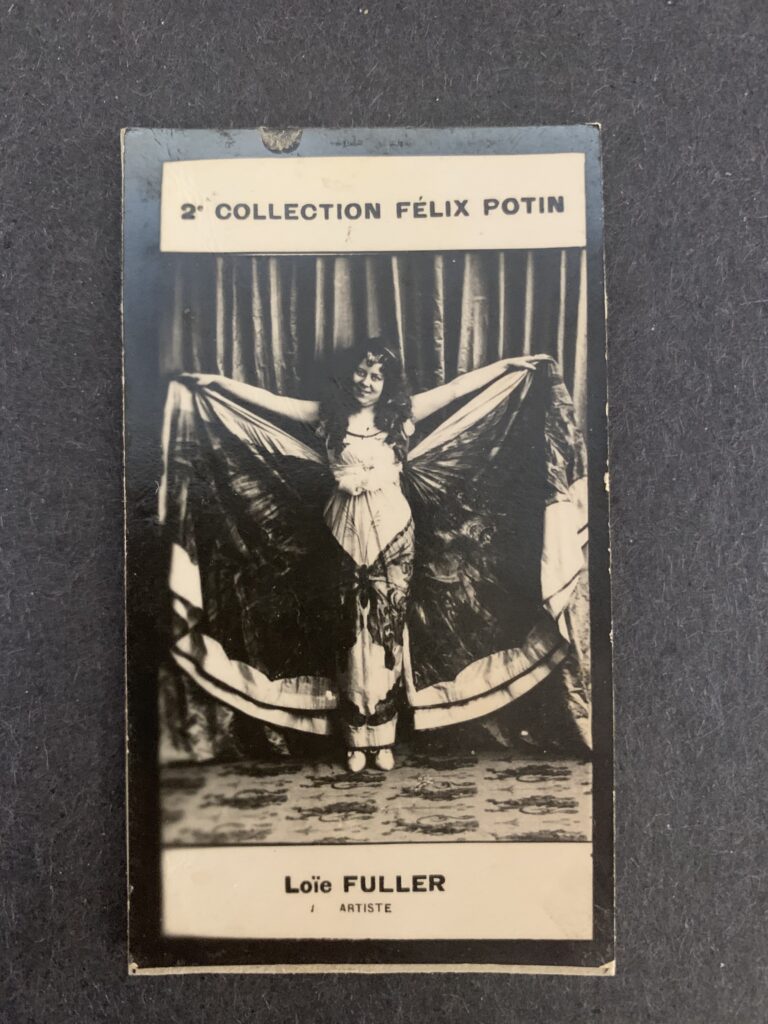
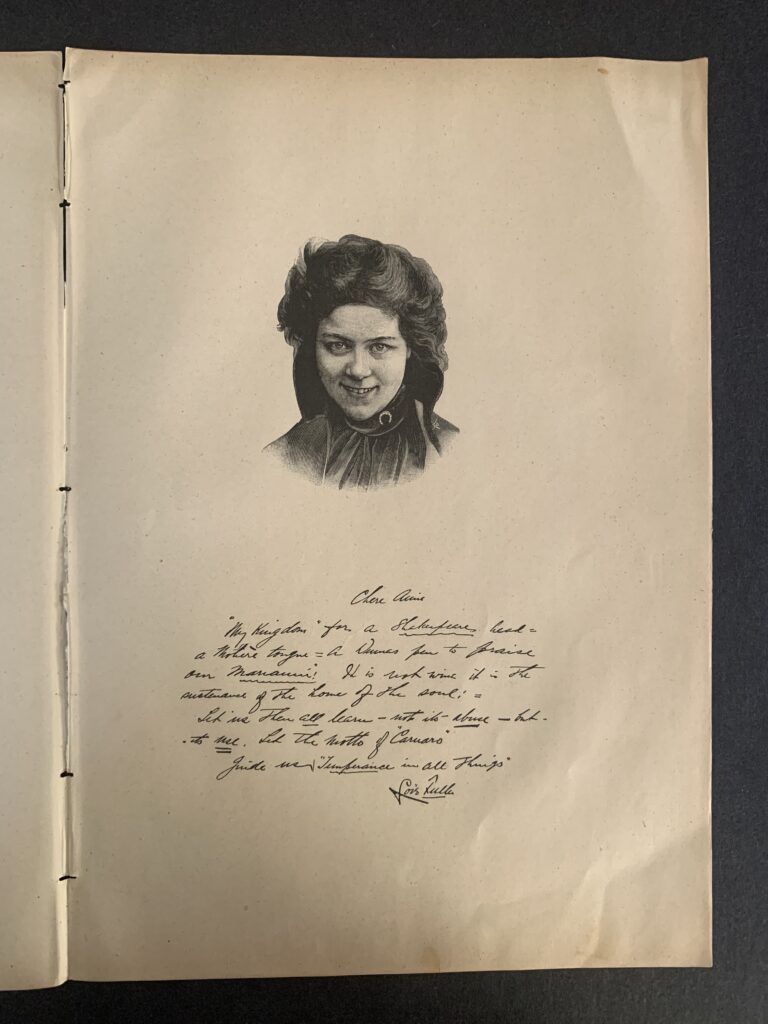
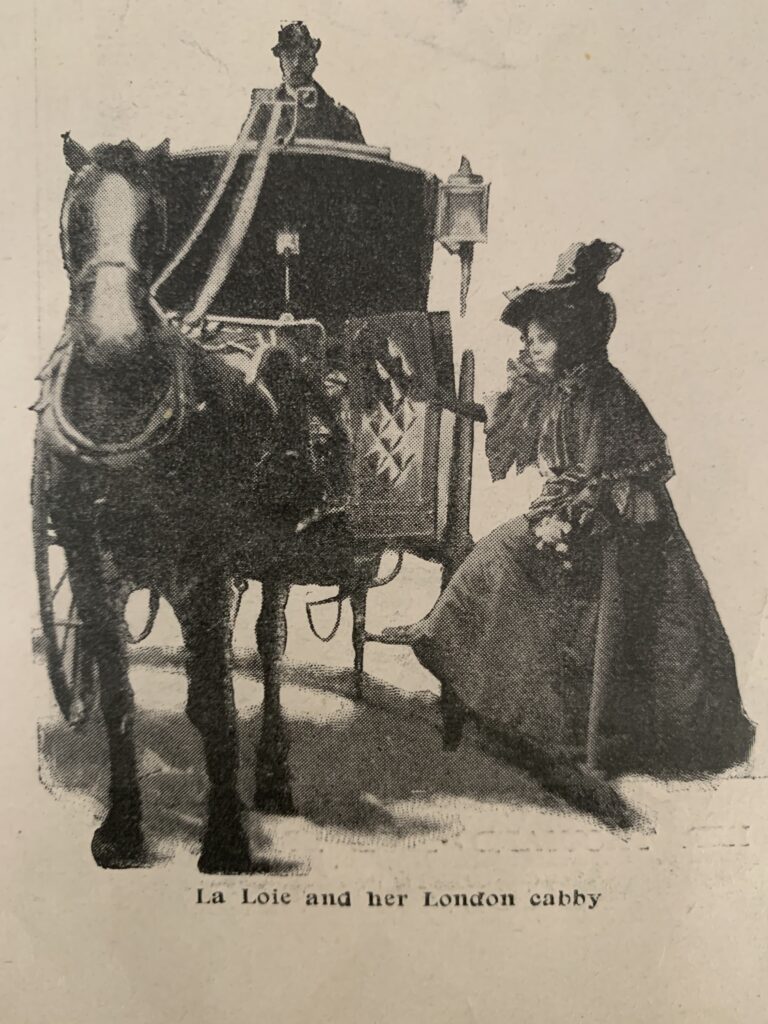
While writing the RADIANT, I collected old postcards, along with antique magazine and newspaper articles featuring Loie Fuller. Here are a few images of La Loie, including a trading card photo of her famous butterfly skirt, and a magazine print of Loie climbing into a London cabby. If you share the images, please credit LizLeeHeinecke.com and the name of any photographer or artist you find on the images.
Radiant is available for preorder now everywhere books are sold! If you’ve preordered a copy of Radiant, click here for a free bookplate signed by Liz.
My newest book- RADIANT, The Dancer, The Scientist, and a Friendship Forged in Light– comes out in February of 2021.
I’ll be sharing photos and other interesting documents that didn’t make thier way into the book on this website, so you can take a closer look at the lives of Loie Fuller and Marie Curie. In addition, I’ll make a Spotify list of the music Loie danced to and post it here for those who want to be musically-immersed in the Belle Epoque.